Model: MT-4-100


Technical advantages:
HOCK cracking can be carried out synchronously with photocatalysis, improving the utilization efficiency of the reactor. Equipment efficiency has been improved, with one less pump in the device and simplified steps for liquid preparation.
The cost of consumables has been significantly reduced, and the maintenance cost of 660nm is only 35% of that of 420nm.
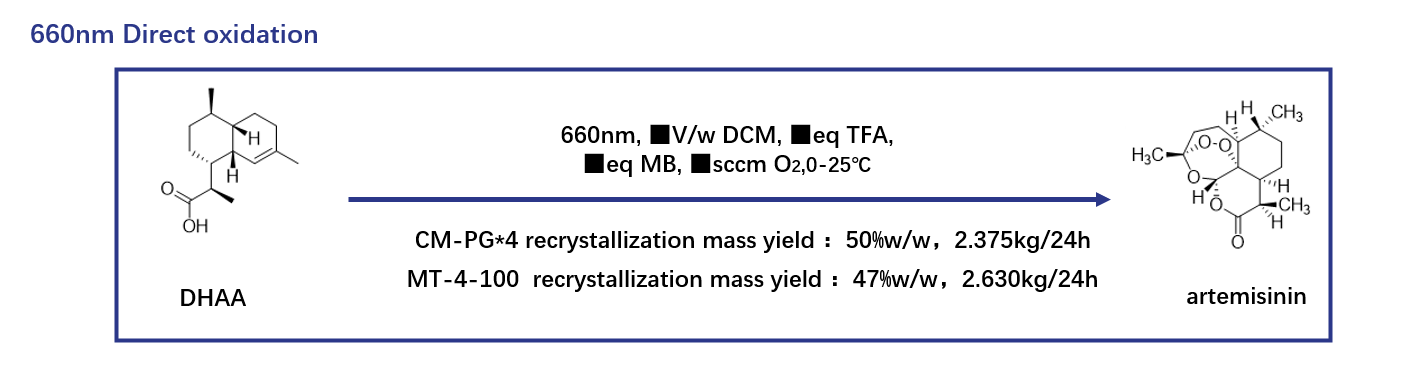
Our unique hybrid tubular reactor has an investment cost of only about 30% of glass microreactors, and has lower maintenance costs, which can quickly recover investment costs. Although its quality yield is only 47%, its overall cost is unparalleled.
Overview of Process Route
We conducted some experiments on the conversion of photocatalytic DHAA to artemisinin and developed corresponding engineering solutions.
We have mainly selected three main technical routes with different characteristics and technical features.
If you are pursuing the highest conversion rate and yield of DHAA to artemisinin, we recommend the (420nm Oxidation after group protection) scheme, which has the highest quality yield of 64% using our reactor. However, you need to obtain DHAA with good purity and protect it to prevent internal generation, but it will increase costs. This method of photocatalytic oxidation cannot be carried out synchronously with HOCK cracking, which will slow down the reaction and affect the yield, so higher equipment investment is required.
The (420nm Direct oxidation) scheme is relatively moderate, with no need for protection in a one-step reaction, shorter steps, and lower purity requirements for DHAA.
If you are pursuing lower hardware costs and lower equipment depreciation, we recommend the (660nm Direct oxidation) solution combined with our unique hybrid tubular reactor. Its investment cost is only about 30% of that of microreactors, and its maintenance cost is lower, which can quickly recover the investment cost. Although its quality yield is only 47%, its comprehensive cost is unparalleled, and photocatalytic oxidation can be carried out synchronously with HOCK cracking without affecting the reaction rate.
CM-PG*4 420nm Process equipment flow chart


MT-4-100 660nm Process equipment flow chart

Cost Evaluation of Devices under Different Technical Routes
Due to the very stable market for artemisinin, the cost of photocatalytic mass production has greatly limited its large-scale production.
Therefore, we have done a lot of work to help customers reduce production costs. Next, we will compare the reactor, light source and catalyst, equipment investment depreciation, consumables and maintenance costs to meet your best needs.
Cost comparison of microreactors

Why does CM-PG have a larger liquid holding capacity!

Comparison of Costs for Different Light Sources and Catalysts

Our Knowledgeable Team is Here to Help
Our team is composed of experienced experts who are eager to help you find a solution that suits your business.
Related Products
CM-D Series Kilo-scale Glass Flow Reactor
Model:
The CM-D series continuous flow reactors is a high-throughput glass microreactor processed from high borosilicate float glass. The four-layer structure design includes the heat exchanger in the reactor to reduce the space occupancy rate.
CM-T Series Lab-scale Glass Flow Reactor
Model:
CM-T is a manually operated, metal-free continuous flow microchannel reactor system for reaction screening & process optimisation. Its modular design gives the user flexibility on the number of feed lines, reactor type & volume.
CM-DG & PG Photochemical Reactors
Model:
A Photochemical reactor is a device that uses light (Photon) to perform a chemical reaction. Typically, the chemical reactions need a high temperature (about 100 to 250 degrees Celsius) for a large production scale. However, this process also gives useless byproducts and losses.

Laryee Technology Co., Ltd. is known as a professional manufacturer of materials testing equipment for determination of mechanical properties.
Navigation
Tel: +86 10 6708 6287
Fax: + 86 10 6708 5997
Email: info@laryee.com
Add.: No.248 Guanganmenwai Avenue, Xicheng District, Beijing China


